Monday, December 3, 2012
Range-Finding
This poem to me portrays death or bad luck. There is a flower hanging half dead, a human was shot at or stabbed, birds protect thier babies, and a spider goes hungry. I think this poem metophorically uses animals, insects, and plants to get across what people go through everyday. "The stricken flower bent double and so hung".( lines 3-4) There are many sicknesses and dieseases that most people deal with, so now are incapable of fully being themselves and hang on to life in any way they can."A butterfly its fall had dispossessed"(line 6), stands for those who just lived their life to the maximum and died. Unlike the flower who only bent in half, the butterfly fell completely "A moment sought in air his flower of rest"(line 7). Also, there is poverty in this world, "The indwelling spider ran to greet the fly, but finding nothing, sullenly withdrew"(lines 13-14). Many of us work, money goes away like nothing sometimes there just isn't enough, not much for food. And for those of those who don't even have a job try to make ends meet, but food is really scarce. There are many eating disorders not only anorexia and billimia, but also small things like ammenia, low/high blood pressure, and diabetes which could eventually get worse within time and without treatment. I see the cobweb as death or the sickness. If a fly gets caught in a web it most certainly will try to fight for its life to get free, if it defeats the web its life will not be the same. That web most likely left some damage on that fly, perhaps took a wing or a leg maybe even left it tramatized. If the web defeats the fly obviously it dies. So what I am trying to say is that what we want to stay away from is the web (by web i mean death/sickness) but some of us get tangled in it.

First Fight. Then Fiddle.
In First Fight. Then Fiddle. the author
describes making beautiful music, like magic, and then talks about the bloody
wars. The music on the fiddle comes first in the poem, while the fighting comes
first in the title, it is ordered that way because Gwendolyn Brooks uses the
music to describe how the fighting overpowers the beauty of music, and only
after, when there is harmony, is the music heard; you have to establish war to
find peace.
In line 2-3, she says "muzzle the note / with
hurting love," what I understood from this line is that they are restraining
the note with damaged, painful, love. Something has gone wrong and it isn’t the
same. When you are making music, especially on the violin, you don’t want to suppress
a note. You want it to ring out and fill the empty space. If you muzzle it, it
sounds scratchy and ugly. The line before (lines 1-2) it says, “Ply the
slipping string / With feathery sorcery.” The word ply makes it sound forceful,
especially if the string is slipping because when you are playing and the
string slips out from under your bow it’s a very rough sound, but “With
feathery sorcery,” makes it seem light and magical, as if under some sort of
playful charm. The two lines clash together, and the rough sound will always
overpower the softer. Without one, would you really be able to understand the
beauty of the other?
“Devote / The bow to silks and honey. Be remote / A
while from malice and from murdering.” (Lines 9-9) Again, “Be remote / A
while..” suggests that they had this malice and murdering before they could
enjoy the sweet sounds they made by the fiddle. If they hadn’t experience such
a tragedy as war, would it have the same effect? Does there really need war for
the lovely sounds to be heard and enjoyed? The poem would agree. It says “Carry
hate / In front of you and harmony behind. / Be deaf to music and to beauty
blind. / Win war. Rise bloody, maybe not too late / For having first to civilize
a space / Wherein to play your violin with grace.” (Lines 9-14) The very last
two lines agree that they have to first win war, and have a place to play. A
place conquered with blood, that finally has peace.
[My mistress' eyes are nothing like the sun]
I
see that this poem is about a love that has been lost. A man writes of his
mistress’ that he was infatuated with, but death had came over her too soon. But
what was love like back in 1609, was it an agreement to the marriage or was it
to gain social status, or was it what was good for you and your family.
In
1609, women didn’t have a lot of power or say in much of anything and the “Suffrage”
hadn’t happen until 1920’s. That’s when women first started to come out of
being just the lovely house wife and into working environment. But back to the
way things were in 1609, almost a three-hundred and eleven years before women
started to fight for their rights, just in the U.S alone. In 1609, women couldn’t
even get jobs really, all women were house wives, but those that did work
worked, with their husbands, for wealthier family as a maid or cook sometimes
both. Some could also have jobs as seamstress. Women couldn’t own property or a
business unless in her husband’s will, she was put down as the successor, which
would mean unless one of your husband’s sons wasn’t old enough to inherit the
property/ business, the bank or whatever would make you move out until the kid
was old enough to take control. So a lot of women were forced into marriage
because they needed someone to take over the business and to take care of her
and her children. Also women were pushed into marring a man that they didn’t
love because of family. Who his family was, what his social status was, what
job he had, how much money he made, and a lot a mother would push her daughter
on to a man like that. Because she knew that, the girl would be taken care of
and wouldn’t have to worry about being on the streets, or having a poor life,
she would have a better life.
A
lot of things decided who you could love back in 1609, men had more of a choice
to love then women, and they weren’t as pressured as the women because they had
more freedom.
"Sonnet" Billy Collins
I found that “Sonnet” is more of a free-verse, it’s very light-hearted. I thought this poem is an example of a more modern sonnet form. There is even a sort of a half rhyme with "beans" in line 4 and the last 2 syllables of "Elizabethan” in line 5. I noticed there is sort of an allusion in the line "launch a little ship on love's storm-tossed seas” (line 3). Also there is another slant rhyme of "end" and "pen” on lines 11 and 12. I also noticed that the author kind of mocks the form and content while pretty much staying true the entire time. However, I really found the last line of the poem the most interesting. "Blow out the lights, and at last come to bed" (line 14). Collins uses iambic pentameter (which is a rhythm that the words in that specific line have) after mocking it as "iambic bongos" earlier. I also really enjoyed the irony of the poem; Collins was really able to show the readers what a sonnet is supposed to be while being sarcastic about it the entire time. He is writing a poem about something related to English, but he is being ironic about it. English is also known as Shakespearean sonnet. English/ Shakespearean sonnet normally has rhyme scheme reflects and it reflects the structure of the poem. I think this style of writing draws readers to it. This "Sonnet" is not like most of the other sonnets because it doesn’t really have a big story behind it and normally it’s a love story which I really thought was neat. Most of the other sonnets in our reading homework had some type of love story behind it, but I thought that “Sonnet” was more about mocking what a sonnet is than really writing a sonnet.
Sunday, December 2, 2012
The New Colossus by Emma Lazarus
This poem, out of all of them was
really able to hit me, it used figurative language very well to help let you
see what the poet was seeing. It had the most beautiful imagery, I knew it was
talking about the statue of liberty without even reading the footnotes. The way it said "A mighty woman with a
torch, whose flame is the imprisoned lightening.", rather than just saying
this is The Statue Of Liberty. It also used the "ee" sound a lot! For
example in line 10-11 "With silent lips. "Give me your tired, your
poor, your huddled masses of yearning to breathe free.." I just loved this
line, when I said tired, poor, yearning, free out loud, I couldn't help but say
it with power and defiance like the patriots would have done. It also used the "oh"
sound a lot. The place I noticed it most was in line 14 when it said "golden
door"
I also
really enjoyed the rhyme scheme, it followed the Petrarchan format perfectly
with a abbaabbacdcdcd scheme. I
really liked that break, if it would have been line after line of rhyming, it
would have become forced and those kind of poems are never fun. This poem uses
a lot of consonance to help the poem flow. My favorite of all the lines containing
consonance was line 3 where it says "sea washed, sunset gates shall
stand" That whole phrase just rolls off the tongue.
Now to
the message of this poem, from this poem I got a sense of freedom and
acceptance. I've read a lot of stories where a new immigrant coming to the
United States sees the statue of liberty and instantly know that all their hard
work to get here was worth it. The United States of America is so accepting of
everyone, which is what I like about this poem. It gives the picture of the
Statue of Liberty telling everyone that no matter what your class, looks, or religion
may be, you are always accepted here.
Sweep Me
What is so attractive about the sonnet is the language it uses. Typically, it makes heavy use of imagery, and the sonnet is so limited (only fourteen lines) that the poets who write them tend to use unusual and powerful diction, in order to create interest.
The sonnet seems driven by sounds, even though that was the title of the last chapter and our current one is supposed to focus on external form. The classic sonnet was written in iambic pentameter, and then there is the inevitable and fluid rhyme scheme.
Take, for example, Diane Ackerman's Sweep Me through Your Many-Chambered Heart. It does not follow any particular metrical pattern (no iambs), nor does it follow suit to either the Shakespearean or Petrarchan forms of the sonnet. Instead it forms a hybrid variation of the two, borrowing the basic rhyme pattern of the Petrarchan sonnet (abba abba cdecde) and combining it with the variation and the paired, two line, stand-alone rhyme of the Shakespearean (abab cdcd efef gg). The hybrid rhyme scheme looks like this: abba cddc ee fgfg.
It is well-known that I am no fan of rhyme, but the form of the sonnet is inoffensive to me. It is subtle and full of grace, clever rather than forced or grating. I found the sounds of Sweep Me so pleasing that I re-read that sonnet several times, which is unusual for me. The language was so interesting and formed around such hard consonants and bright vowels. Look at the first two lines, and the assonance achieved by the repetitive, bright "e" vowel:
Sweep me through your many-chambered heart
if you like, or leave me here, flushed
Or how about the consonance and alliteration of the middle lines (and the continued assonance generated by use of the recurring "e")?
...Weeks
later, till I felt your arms around
me like a shackle, heard all the sundown
wizardries the body speaks.
Also, I'm a fan of enjambment (if no one could tell). It makes the movement of the sonnet more fluid and--appropriately--sweeping. It fosters a sense of urgency and excitement in the language, so that your heart is beating rapidly by the time you get to that delightful and peculiar turn of phrase that concludes the sonnet:
thinking I'd heard your footfall on the stair,
I listened, heartwise, for the knock.
Saturday, December 1, 2012
I thought you'd appreciate this :D
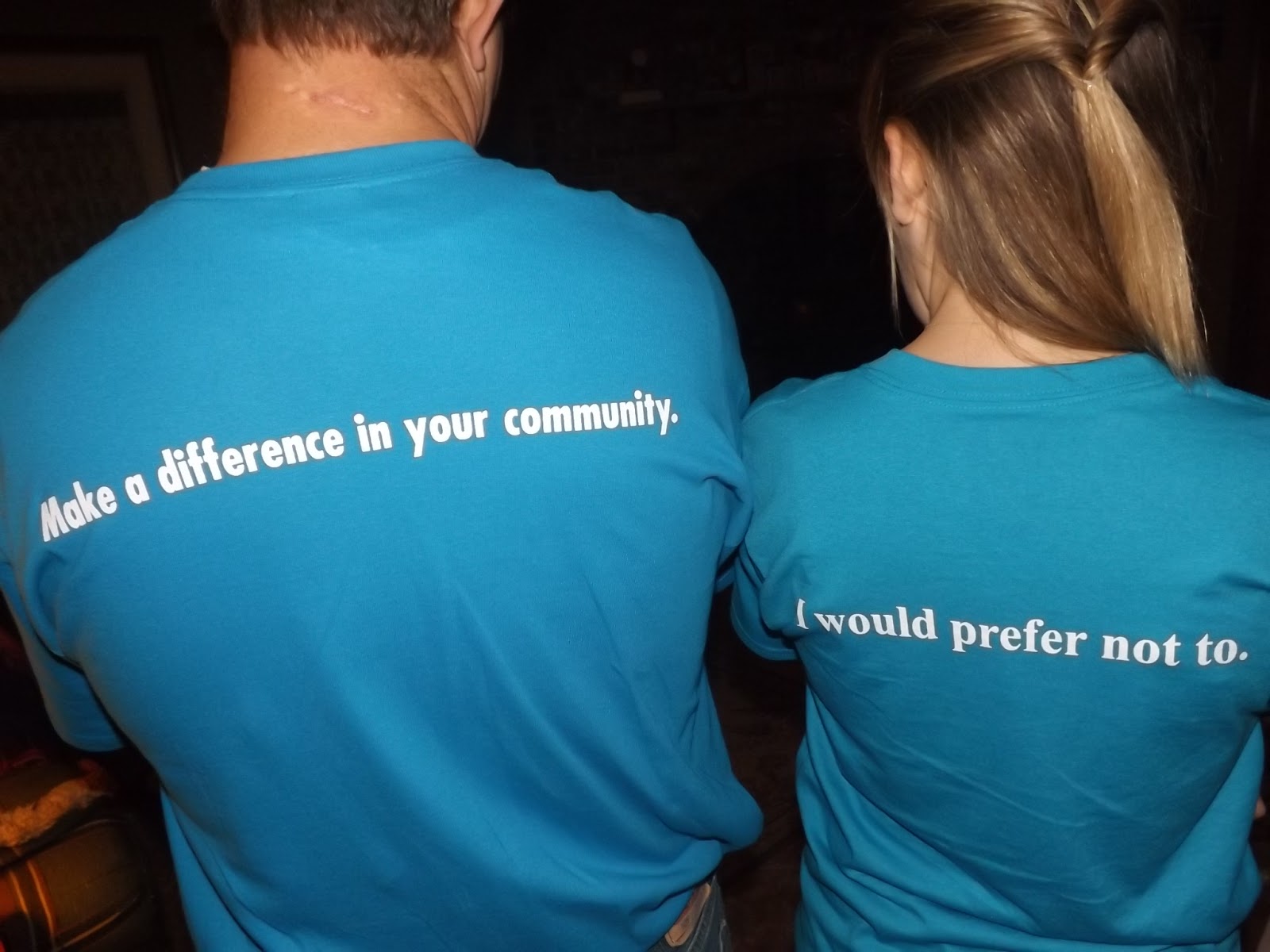
Okay, this is something I thought you guys would appreciate. So as you know, I left class Friday so that I could get some community service hours in. I went with a volunteer group from HP that my dad is a part of and we realized when we got to the place that my shirt was the same color as their volunteer shirts, so at least I fit in a little bit right? Well, if someone was paying close attention when we stood next to each other this is what it would have looked like...

Hopefully this picture is working... in any case it made us all laugh pretty hard. :D
Hopefully this picture is working... in any case it made us all laugh pretty hard. :D
Subscribe to:
Posts (Atom)